Hinduism is a living way of life—a rich tapestry of wisdom, philosophy, and spiritual freedom encouraging everyone to discover their own unique path to truth.
Explore the World's Oldest Living Tradition
Understanding Hinduism & Its Core Essence
What is Hinduism?
One of the world's ancient spiritual traditions, Hinduism is a diverse ocean of philosophy, devotion, and ethical practices seeking ultimate truth and self-realization.
What is Sanatana Dharma?
The traditional name, meaning "The Eternal Way." It represents timeless principles of righteousness, duty, and cosmic order guiding existence.
A Philosophy & Way of Life
- Philosophy: Deep inquiry into truth & reality.
- Way of Life: Ethics & balanced daily living.
- Religion: Devotion, sacred rituals & tradition.
What Makes It Unique?
- No Single Founder: Wisdom from ancient sages.
- Vast Scriptures: Vedas, Upanishads & Gita.
- Freedom of Path: Knowledge, devotion, or meditation.
Core Pillars & Universal Values
Satya (Truth)
Honesty in thought, word, and deed.
Shanti (Peace)
Inner tranquility and global harmony.
Ahimsa (Non-violence)
Compassion toward all living beings.
Respect for All
"The world is one family."
Origin & History of Hinduism
Trace the continuous 4,000-year evolution of Sanatana Dharma—from the sacred chants of the Vedic rishis to a vibrant global spiritual tradition.
Ancient Origins & Vedic Era (c. 3300–500 BCE)
Foundational AgeFrom the urban rituals of the Indus Valley Civilization to the oral composition of the Four Vedas and Upanishads, laying down concepts of Brahman, Atman, and Karma.
The Era of Epics (Ramayana & Mahabharata)
Classical EraThe composition of the great epics, the transformative wisdom of the Bhagavad Gita on duty and devotion, and the emergence of Vaishnavism, Shaivism, and Shaktism.
The Era of Devotion (Bhakti Movement)
Spiritual ReformA widespread spiritual movement driven by poet-saints (Alvars, Nayanars, Kabir, Mirabai) that democratized spiritual access using regional languages and heartfelt devotion.
Hinduism in the Modern World (19th Century–Present)
Global RenaissanceThe 19th-century Renaissance led by Vivekananda and Dayananda Saraswati, the application of Ahimsa by Mahatma Gandhi, and the global spread of Yoga, Vedanta, and temple arts.
Daily Practices & Sacred Worship (Sadhana)
Transforming everyday routines into intentional moments of peace, presence, and divine connection.
Pujas & Prayers
Simple daily rituals involving light, flowers, incense, and genuine gratitude to invite divine energy and positive vibrations into the home environment.
Mantras & Chanting
Using sacred sound vibrations like Om to quiet the mind's restlessness, raise inner clarity, and align personal energy with cosmic rhythms.
Living Sadhana
Turning everyday actions into mindful spiritual practice through kindness, conscious meditation, patience, and regular self-reflection.
Celebrating Life: Festivals & The Sacred Calendar
Honoring the cosmic dance of time, light, self-discipline, and natural cycles through ancient traditions.
Festivals of Joy
Celebrations like Diwali (Festival of Lights), Holi (Festival of Colors), and Navratri honor the victory of good over evil and welcome the changing seasons with community, light, and gratitude.
Fasting & Vrats
Thoughtful periods of self-discipline, inner quiet, and conscious nutrition. Fasting (Vrat) purifies both mind and body, re-aligning personal willpower with quiet spiritual focus.
"Self-mastery leads to clarity of thought and peaceful living."
The Panchang (The Sacred Lunar Calendar)
The traditional Vedic astronomical calendar that aligns human activities with planetary rhythms—guiding optimal timing for celebrations, sacred rituals, fasting, and milestone life events.
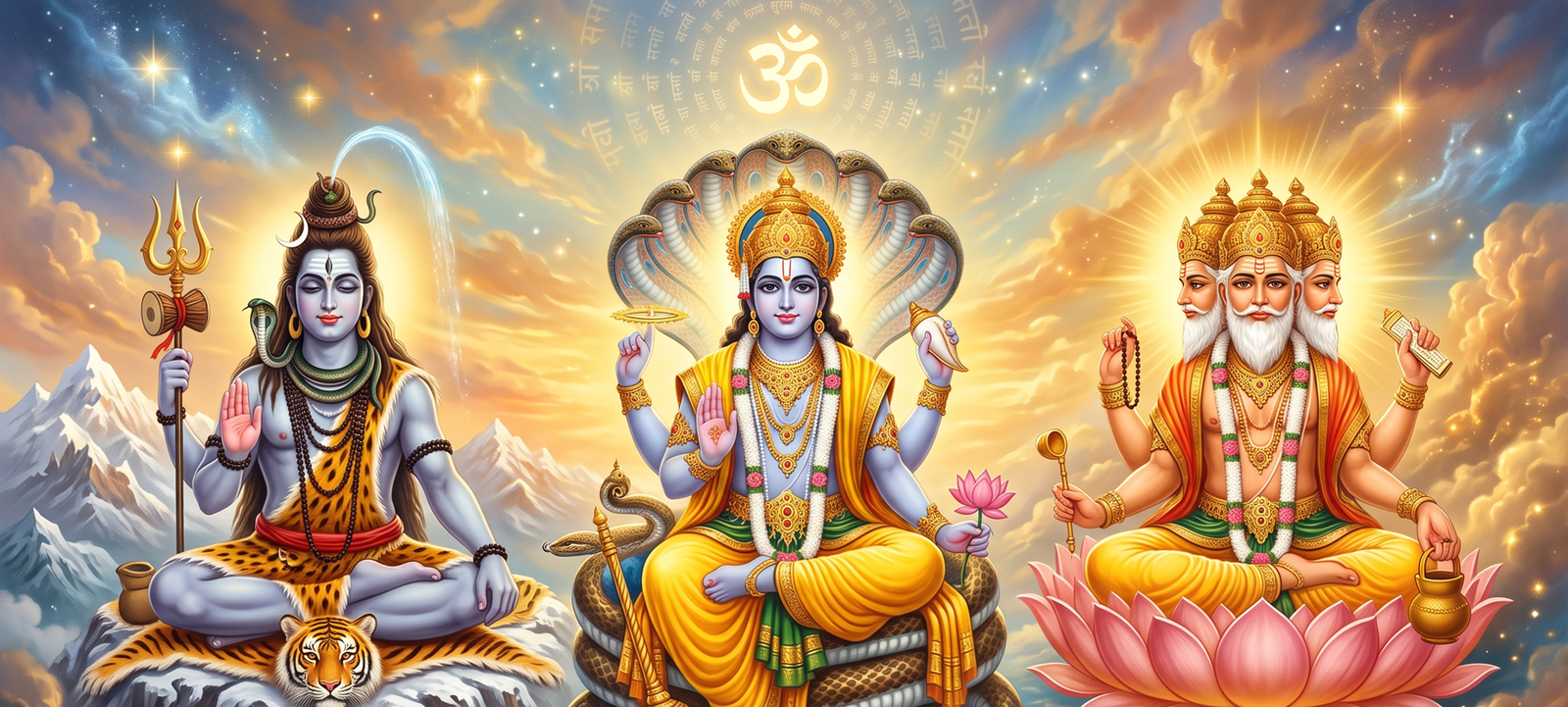
The Divine Trio, Avatars & The Cosmos
One Supreme Reality, Many Forms
Hinduism teaches that one infinite Divine Being (Brahman) expresses itself through distinct cosmic aspects:
Avatars & Divine Descent
Whenever cosmic order and righteousness (Dharma) are threatened, the Divine descends to Earth in physical or spiritual forms to restore peace and protect existence.
Celebrated incarnations like Lord Rama and Lord Krishna serve as timeless examples of righteousness, devotion, and moral action in action.
Cosmology & Eternal Time
In Hindu worldview, time is not linear but cyclic. The universe moves continuously through grand, endless rhythms of creation, maintenance, and dissolution.
This eternal cosmic balance reminds us that every ending is simply the threshold to a renewed beginning.
Sacred Spaces: Temples & Pilgrimages (Tirthas)
Crossing points where physical landscape meets infinite divine consciousness.
Living Temples
Architectural marvels engineered as energetic gateways—connecting Earth to the Divine through precise sacred geometry, consecrated space, and continuous devotion.
Sacred Journeys
Traveling to holy sites like Varanasi, Kedarnath, or Rameswaram to cleanse the mind, seek blessings, and experience deep personal devotion.
Yoga & Meditation: Paths to Union
More Than Physical Exercise
Yoga fundamentally means "union"—the harmonious alignment of body, mind, and spirit to awaken deeper awareness and inner peace.
Four Classical Pathways to Peace
Bhakti Yoga
Path of Devotion
Channeling emotions and love toward the Supreme through worship, prayer, and selfless surrender.
Karma Yoga
Path of Action
Performing duty and service selflessly without attachment to praise or personal reward.
Jnana Yoga
Path of Wisdom
Attaining truth through deep intellect, study of scripture, self-inquiry, and discernment.
Raja Yoga
Path of Meditation
Mastering the mind through meditation, mental concentration, and conscious focus.
Living Mindfully: Karma & Dharma Today
Timeless spiritual principles transformed into daily practical wisdom for modern integrity and conscious action.
Dharma
Doing the right thing—living with integrity, compassion, and profound respect for nature and fellow beings in every moment.
Karma
The eternal law of cause and effect. Every positive, intentional action seeds future happiness—encouraging us to act with care today.